Reviewed · KUALA LUMPUR TOURS
Singapore, Thailand & Malaysia eSIM: 0.5GB Daily to 30GB-30 Days
This eSIM solves one of the first problems you face after landing in Kuala Lumpur: getting online without hunting for a SIM counter. You receive the QR code within minutes, and you can install it at the airport before you even leave for the city. The plan also covers Singapore and Thailand, which is handy if your trip crosses borders.
I like two things here: hotspot use is supported, and the prepaid plan has no contract or automatic renewal. The main catch is important: installation starts the validity period, and the purchase is non-refundable if your phone is incompatible or your plans change.
Key points at a glance
- Three-country coverage: Use the eSIM in Singapore, Thailand, and Malaysia, with local network partners such as Singtel, AIS, DTAC, Celcom, and Digi.
- Fast setup by QR code: Install it from the email before departure, then activate data when you arrive.
- Plans for different users: Choose from daily options beginning at 0.5GB or fixed allowances up to 30GB for 30 days.
- Data only: You get mobile internet, not a local phone number for calls or SMS.
- Hotspot supported: Share the connection with another device when needed.
- Careful timing matters: The validity clock begins when you install the eSIM, not when you first browse.
A practical data plan for a three-country trip
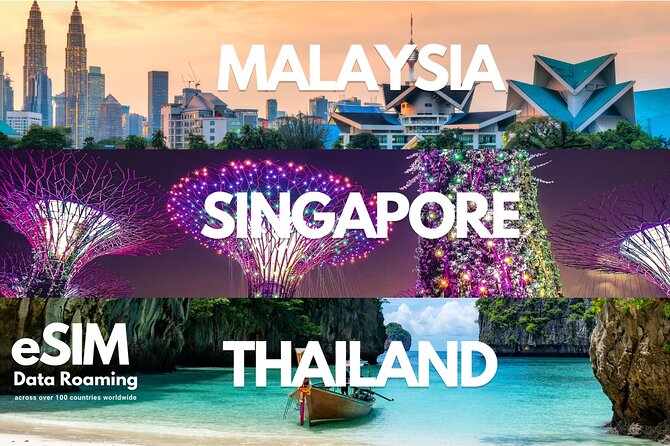
This product is best understood as a travel connection, not a guided tour. There is no sightseeing route, transport service, or local host. You purchase a digital SIM, install it on a compatible phone, and use mobile data across Singapore, Thailand, and Malaysia.
That distinction matters. The listed starting price of $3.18 per person is low for a prepaid connection, but the final value depends on the plan you choose. The available choices range from 0.5GB-per-day packages to fixed plans reaching 30GB over 30 days. Check the exact allowance before paying, since a light phone user and a constant video watcher need very different amounts of data.
For maps, messaging, ride-hailing, email, translation, and occasional browsing, even a small daily allowance may be enough. If you upload photos, use video calls, stream music, or share your connection, a larger fixed plan makes more sense.
A few more trips around Kuala Lumpur worth a look
- Kuala Lumpur: Batu Caves Half-Day Tour with Pick-Up Option
★ 4.5 · 4,288 reviews - Private Half-Day Batu Caves and Cutural Tour in Kuala Lumpur
★ 5.0 · 3,107 reviews - Sambal Streets Kuala Lumpur Food Tour with 15+ Tastings
★ 5.0 · 2,438 reviews
Installing the QR code before you fly

The setup is simple in principle. You receive the QR code by email, open the eSIM settings on your phone, scan the code, and follow the installation prompts. The service says the code is sent within minutes, so you can prepare at home or while waiting at the airport.
One traveler installed the eSIM a couple of hours before flying and switched it on after landing in Kuala Lumpur. That is the right general approach. Install it while you still have reliable Wi-Fi, but pay close attention to the activation wording. The validity period starts upon installation, not necessarily when you first use mobile data.
This creates a small timing trap. If you buy the package weeks ahead and install it immediately, you may use up part of the validity before your trip. You must begin using it within one month of purchase, but once installed, the plan clock starts. For a 30-day plan, wait until your departure is close unless you have a clear reason to install it earlier.
Your phone must also be unlocked and eSIM-compatible. Most phones bought in China and Hong Kong are specifically noted as not supporting eSIM, so check the exact model before purchasing. Do not rely only on the phone brand. Compatibility can vary by market and model.
Landing in Kuala Lumpur with data ready
Kuala Lumpur is a good place to appreciate a ready-to-use eSIM. You may need directions, airport information, a ride-hailing app, or a message to your accommodation soon after arrival. With the eSIM installed, you can turn on the travel line and keep your regular SIM available for other functions.
The service connects through Malaysian networks listed as Celcom and Digi. Speeds may reach 4G LTE or 5G, depending on local availability, network conditions, and your phone. That wording is worth noting. The eSIM gives you access to a local network, but it does not promise 5G at every street corner or inside every building.
Actual use reported through the service has been encouraging in Kuala Lumpur. One person found the connection stable and the installation easy, while another used it immediately after landing with no reported trouble. That makes the eSIM particularly useful for the first few hours of a trip, when a small connection problem can become a large nuisance.
Still, no mobile service works perfectly in every spot. Your speed can change with network congestion, signal strength, and the local partner available at the time. If your work depends on a constant high-speed connection, treat this as a travel convenience rather than a guaranteed office connection.
Crossing into Singapore and Thailand
The main advantage over a Malaysia-only SIM is the regional coverage. You can use the same eSIM in Singapore and Thailand, with Singapore connections listed through Singtel and Thailand through AIS or DTAC. That saves you from buying and swapping a new SIM each time you cross a border.
It also reduces the chance of misplacing a tiny physical SIM. Keep your regular SIM in the phone, set the eSIM as the mobile data line, and change the data line as needed. The exact steps depend on your phone, but the basic benefit is clear: one digital connection for a multi-country route.
The coverage list also includes many other countries, but the relevant promise here is Singapore, Thailand, and Malaysia. Do not assume every country listed in the wider network information belongs to the same plan or has identical conditions. If your itinerary goes beyond these three countries, verify the selected package carefully.
For a border-crossing trip, the plan is most useful when you want continuity. You can keep messaging and maps working as you move between countries, rather than stopping at each border to find a shop, compare packages, and register another SIM. That convenience has real value, even if the cheapest local SIM in one country might cost less.
Same base, a different sort of day:
- Historical Malacca Guided Day Tour (Shared Tour)
★ 5.0 · 2,172 reviews - Kuala Lumpur: Sambal Street Food Tour with 15+ Tastings
★ 4.9 · 1,657 reviews - From Kuala Lumpur: Batu Caves Cultural Temple Tour
★ 4.7 · 1,453 reviews - Genting Highland & Batu Cave Guided Day Tour (SIC/Shared Tour)
★ 5.0 · 1,289 reviews
Choosing between daily and fixed data
The plan structure deserves a close look. Daily packages reset each day at 0000, plus 8 GMT. After the listed high-speed daily allowance is used, data continues at 128 kbps. Fixed plans work differently: once you use the selected high-speed amount, data continues at the same reduced speed for the rest of the plan.
The 128 kbps fallback is enough for basic messaging apps, according to the product details. It is not a comfortable speed for large photo uploads, video, streaming, or demanding map use. Think of it as a safety net that may keep simple messages moving, not as a replacement for full-speed data.
A daily plan suits you if your use is fairly even from day to day. It gives you a fresh allowance at the reset time, but the midnight schedule may not match your habits. If you use most of your data during a long travel day, you may need to wait for the reset before full-speed service returns.
A fixed plan gives you one larger pool. This can work better if your usage varies, with quiet days in Singapore followed by heavy map and photo use in Thailand. The risk is that you may burn through the allowance early if you stream or use your phone as a hotspot.
Before buying, ask yourself three simple questions:
- Will I mainly use maps, messaging, and web pages?
- Will I upload photos or make video calls?
- Will I share the connection with a laptop or another phone?
Your answers should guide the allowance more than the lowest advertised price.
Hotspot use and the data-only limit
Hotspot support is one of the most useful features. You can share the eSIM connection with another device, which may help if you carry a tablet or laptop. It also gives you a backup connection when two people need internet access and only one phone has the eSIM installed.
Hotspot use can consume data quickly, so a small 0.5GB daily plan may not last long if you connect a computer. Laptop updates, cloud backups, and high-resolution images can use far more data than ordinary phone browsing. Keep automatic updates and photo backups under control if you are working with a small allowance.
The eSIM does not include a phone number. You cannot use it to make ordinary phone calls or send standard SMS messages. Messaging apps can still work over data, and the reduced-speed service is specifically described as suitable for messaging apps, but traditional calls and texts remain outside the package.
This is not a major problem for many visitors. You can keep your home SIM active for calls or use internet-based services over the data connection. Just remember that your regular SIM may create roaming charges if it remains active for cellular data. Check your phone settings and your home provider before departure.
Speed, coverage, and what 4G or 5G really means
The connection uses major local networks at 4G LTE or 5G speeds where available. That is the right level of service for normal travel tasks. You should be able to use online maps, bookings, messaging, email, and general browsing without needing a separate Wi-Fi hunt every time.
The phrase where available does the work here. It means the network, your phone, and the location must all support the faster connection. A 5G label in the plan description is not a promise of constant 5G service throughout Kuala Lumpur, Singapore, or Thailand.
The strongest practical advantage is stable access, not a particular speed test. A connection that works when you need directions at the airport is more valuable than an impressive number that disappears indoors. The available evidence points to reliable use in Kuala Lumpur, but conditions can vary by place and time.
At 128 kbps after the high-speed allowance is gone, you should lower your expectations. Basic text messages may continue, but image-heavy pages and video are likely to be frustrating. Keep your phone from wasting data on automatic downloads, app updates, and high-quality media.
Price, value, and the no-refund risk
At $3.18 per person as the listed starting price, this is an inexpensive way to secure basic mobile data. The value improves if you visit all three covered countries, use hotspot support, and want to avoid buying separate SIMs.
The low price does not remove the need to read the plan details. Some packages have daily limits, while others have a fixed high-speed allowance. Once that allowance is used, the connection continues at reduced speed. You are paying for convenience and a defined data package, not unlimited high-speed use in the usual sense.
The purchase is prepaid, with no automatic renewal and no contract. That is good news for a short holiday. You will not need to remember to cancel a monthly plan after returning home.
The stricter point is cancellation. The purchase is non-refundable and cannot be changed, including for compatibility problems or an altered itinerary. I would check your phone model, confirm that it is unlocked, and settle your travel dates before paying. A few minutes of preparation can prevent a completely avoidable loss.
Who will get the most from this eSIM
I would choose this option if you are taking a multi-country trip through Singapore, Thailand, and Malaysia and want data ready at the airport. It is also a good fit if you dislike handling physical SIM cards or need a connection for a second device.
It suits light and moderate phone use particularly well. Maps, messaging, bookings, translation, and occasional browsing fit the purpose. The daily reset can also help you control your usage if you prefer a clear limit.
I would look more carefully at the allowance if you work online, stream often, upload large files, or plan to use hotspot for long periods. A larger fixed plan may be the safer choice, but you still need to watch the high-speed total.
This is not the right purchase if your phone lacks eSIM support, is carrier locked, or you need a local phone number. It also offers little comfort if you want guaranteed high-speed data at all times.
Should you book it?
Book this eSIM if you value quick setup, regional coverage, and a low one-time price. Its best feature is simple: you can arrive in Kuala Lumpur with data ready, then keep using the same digital connection in Singapore and Thailand.
Before you buy, confirm three things: your phone supports eSIM, your phone is unlocked, and the selected data allowance matches your habits. Install it close to departure rather than far in advance, since installation starts the validity period.
For a phone used mainly for maps and messages, this is a sensible budget choice. For heavy data use, choose the largest allowance you can justify and remember that reduced-speed service begins after the high-speed limit is reached.
FAQ
How long is the eSIM valid?
Plans are available for periods up to 30 days. The exact validity depends on the package selected.
Does the eSIM cover Singapore, Thailand, and Malaysia?
Yes. The included regional coverage is Singapore, Thailand, and Malaysia.
Does the eSIM include phone calls or SMS?
No. It is data only and does not include a phone number for ordinary calls or SMS messages.
Can I use the eSIM as a mobile hotspot?
Yes. Mobile hotspot use is supported.
When does the eSIM validity begin?
The validity starts when you install the eSIM. You should begin using it within one month of purchase.
What happens after I use the high-speed data allowance?
Daily plans reset at 0000, plus 8 GMT. Until the reset, and for fixed plans after the selected allowance is used, data continues at 128 kbps.
Just added around Kuala Lumpur
- Transit Tour Private Tour (Ex Port Klang Cruise Centre/KLIA 1 &2)★ 5.0 · 10 reviews
- Sunway Lagoon Ticket (One Day Pass)★ 3.5 · 5 reviews
- Private Kuala Lumpur Shore Excursions★ 4.5 · 22 reviews
- Private Transfer: Kuala Lumpur International Airport to or from Hotel★ 4.5 · 14 reviews
- Kuala Lumpur City & Batu Caves Temple Private Tour★ 4.5 · 3 reviews
- Full Day Melaka Private Tour from Kuala Lumpur★ 4.0 · 5 reviews
- Private Port Klang Cruise to Kuala Lumpur City Tour★ 5.0 · 3 reviews
- Kuala Lumpur International Airport Transfers★ 5.0 · 4 reviews
Kuala Lumpur Tours, compared.

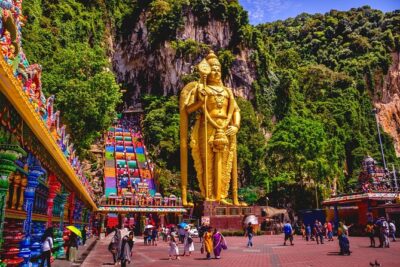
Private Half-Day Batu Caves and Cutural Tour in Kuala Lumpur
Read our review →
Sambal Streets Kuala Lumpur Food Tour with 15+ Tastings
Read our review →
Historical Malacca Guided Day Tour (Shared Tour)
Read our review →


Genting Highland & Batu Cave Guided Day Tour (SIC/Shared Tour)
Read our review →